Last updated by Maggie on
You’re not bad with time. You’re trying to manage something your brain doesn’t naturally feel.
You check the clock, do the quick mental math, and think, “I’ve got plenty of time.”
And then something shifts. You get pulled into one small thing, then another. Nothing feels like a big decision. Nothing feels like it should take long. But when you look up again, the time you thought you had is gone and now everything feels rushed.
That’s the part that doesn’t make sense from the outside. It looks like poor time management. It feels like something else entirely.
Making Time Harder to Ignore
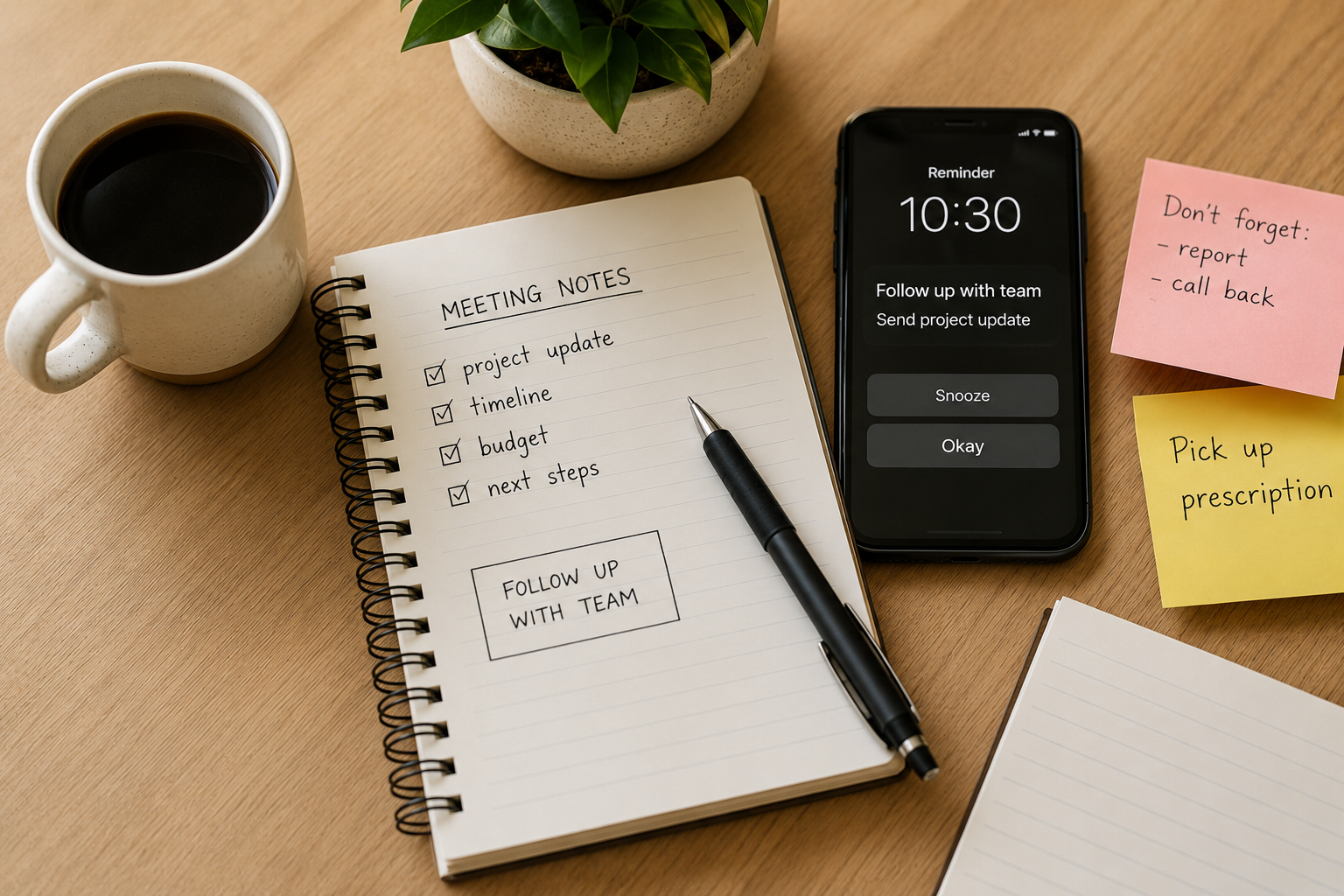
Instead of relying on your brain to hold time in the background, it helps to bring time into your environment where you can see it.
External cues stay visible, which makes time easier to notice when your attention is pulled into something else.
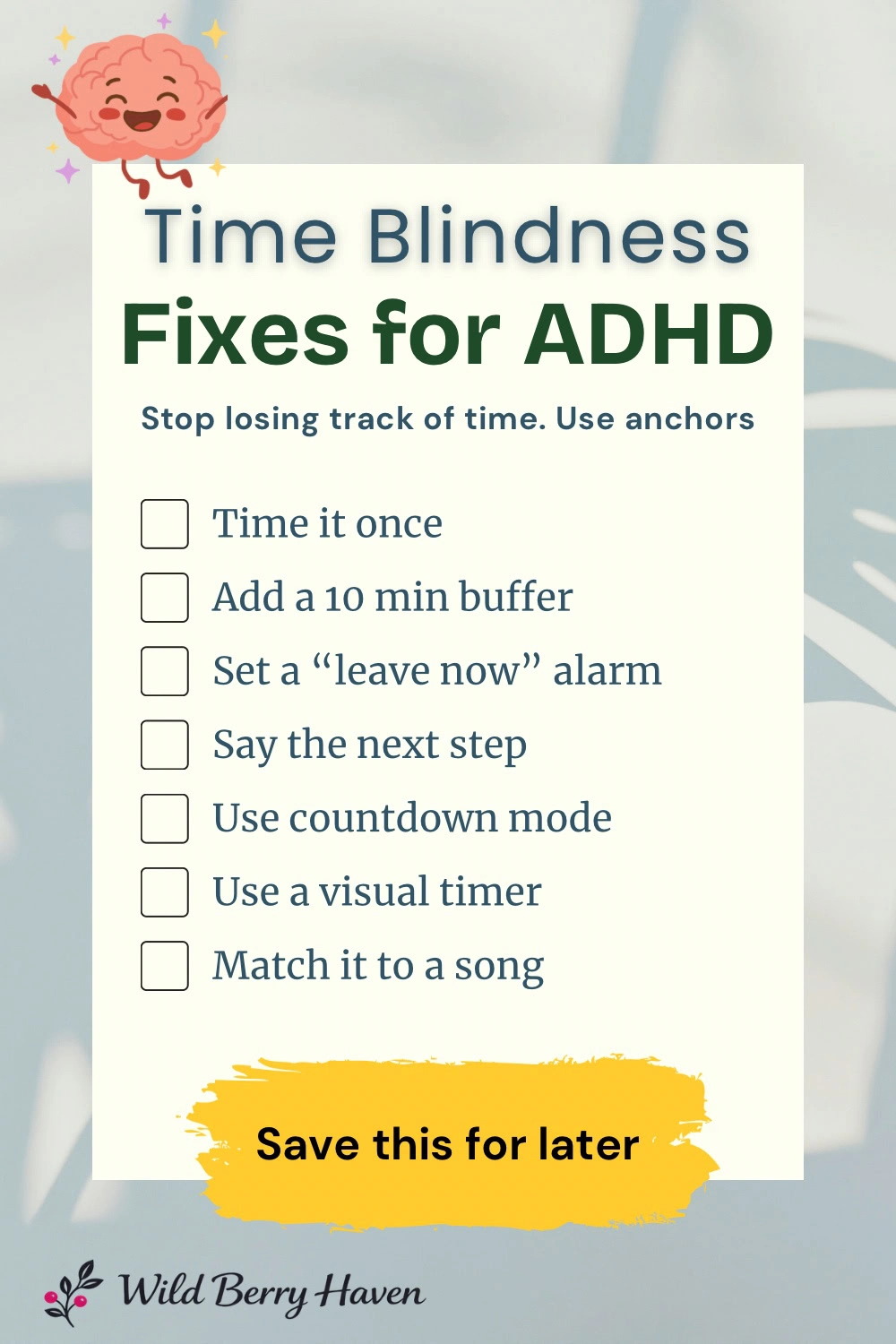
- Time it once. Measure a familiar task from start to finish so you have a real duration to plan around.
- Add a 10-minute buffer. Allow an extra ten minutes for finding things and getting out the door, then adjust that buffer to your experience.
- Set a “leave now” alarm. Label the alarm with the action you need to take, such as “Put on shoes and leave.”
- Say the next step. Name one concrete action aloud, such as “Pick up my keys,” as you switch tasks.
- Use countdown mode. Set a countdown to your departure time so you can check how many minutes remain.
- Use a visual timer. Place the timer where you can see the remaining time while you work.
- Match it to a song. Use a familiar song as a cue for a short task, with the end of the song marking a moment to check your progress.
What’s Actually Going On With ADHD Time Blindness
Time blindness is the difficulty of feeling time pass clearly while your attention is somewhere else. You may check the clock, know what time it is, and still lose touch with how quickly the next few minutes are moving.
This sits inside executive function because leaving on time requires planning, attention, task switching, and time awareness to work together.
So even if you check the time, understand it, and fully intend to leave when you should, that information can fade the moment your attention shifts. It is not that you ignored it. It just didn’t stay available long enough to guide your next step.
If you want the broader picture of how these pieces connect, you can read more about executive function here.
This is also where time perception plays a role. When something has your attention, time moves quickly. When it doesn’t, it feels vague or stretched. There is no steady internal signal keeping everything on track.
Why You Can Check the Time and Still Lose It
You can see the time and know exactly what it means, but once your attention moves, time may stop feeling present enough to guide your next action.
Something else becomes more immediate. A task, a distraction, a thought, or one small thing that feels quick enough to squeeze in.
From the outside, it can look like you forgot. Inside the moment, it often feels like time slipped out of focus.
The Tiny Time Leaks You Don’t See Coming
Most people plan around the obvious part. The drive. The appointment. The time they need to be there.
What gets left out are all the in-between steps that don’t feel like “time decisions” in the moment. Finding your shoes. Grabbing your keys. Refilling a drink. Checking one thing on your phone. Realizing you forgot something and circling back.
Each one feels small enough to ignore. Together, they quietly use up the margin you thought you had.
This is usually the moment where it feels like time disappeared. But if you replay it, it didn’t. It just got used up in a bunch of small things that didn’t feel important while you were doing them.
My son has Little League baseball games on a lot of Saturdays in the spring, and I swear the hour before we leave has trapdoors in it. I know what time I need to leave to get to the field on time, but I still lose track of that space between “I need to leave in an hour” and “we need to get in the car now.” Then I’m suddenly grabbing the folding chair, my Nikon camera, whatever we need for the car, and running back to the kitchen for the travel coffee mug I just filled.
Leaving Takes More Than You Think
Leaving is not one action. It is a series of small shifts that all take time. You have to stop what you are doing, decide to switch, physically move into the next step, and then keep going without getting pulled off track.
It sounds simple until you’re actually in it. Task switching is one of the areas where executive function struggles show up the most, and it slows everything down in ways that are easy to underestimate.
So when you think, “I’ll leave in five minutes,” you are usually only thinking about the final step, not everything it takes to get there.
“Be There” Time Is Not “Leave” Time
This is one of the biggest mismatches.
The appointment time feels like the important number, so that is the one your brain holds onto. But being somewhere at 8:00 means leaving earlier than that, and that leave time has to be calculated, remembered, and protected.
If you don’t break it down, your brain treats the appointment time like when you should start, not when you should already be there.
Why Alarms Don’t Always Change Anything
Alarms can help, but they are not always enough on their own.
If you are in the middle of something, the alarm becomes a quick interruption, not a shift in direction. It goes off, you acknowledge it, and then your attention slides right back to what you were doing.
Hyperfocus makes this even harder. When your brain is locked into something, pulling away from it takes more effort than the alarm alone provides.
It’s Not Just About Being Late
This same pattern shows up in other places too. Missed deadlines. Late replies. Tasks that felt like they would take a few minutes and turned into something longer.
You can care about all of it and still have the same breakdown happen, because the issue is not effort. It is how time is being tracked moment to moment.
This can overlap with working memory when a reminder to leave, reply, or switch tasks disappears after your attention moves. If that part feels familiar, my ADHD working memory support guide explains why information can disappear before you use it.
This happens with texts too. A friend or family member will message me about making plans and ask something simple, like, “Hey, are you free on the 30th instead of the 24th?” I’ll stare at the message and think, “Hmm, am I free then?” Then my brain starts pulling up whatever is top of mind, and suddenly I’m mentally sorting through appointments, games, errands, and random things I’m probably forgetting.
At some point I realize I can’t hold all of that in my head, so I tell myself I’ll check my calendar later. That feels like the responsible thing to do in the moment. But then later turns into not responding, and now I haven’t even told them, “Let me check,” or “The 30th sounds great.”
Affiliate disclosure: As an Amazon Associate I earn from qualifying purchases. If you buy through links in this post, I may earn a commission at no extra cost to you.
Helpful tool for ADHD time blindness
Visual timers work differently than regular timers. Instead of disappearing into the background, they sit right in front of you while you’re doing something else. That’s what makes them easier to notice when time starts slipping.
A visual timer like the Time Timer shows time passing in a way you can actually see, which makes it easier to catch when you need to shift before everything turns into a rush.
Backup if you ignore timers without meaning to
If one reminder goes off and you automatically silence it, a repeating interval timer can work better. It keeps bringing your attention back instead of relying on one moment you might miss.
This can be helpful for hyperfocus, task switching, leaving the house, or remembering to stop when “just one more minute” keeps stretching.
For support beyond timers, my ADHD time blindness tools guide also covers an alarm clock for morning routines, a digital calendar, and reminders on your wrist.
What to Take From This
If you have ever wondered how you can have enough time and still end up late, it is not because you are careless.
It is because time is not staying visible or present in the way most systems expect it to.
When you shift from trying to manage time internally to making it easier to see externally, things do not become perfect, but they do become easier to catch before everything turns into a rush.