Last updated by Maggie on
I can be halfway through a task, answer a question, and come back unsure of what I was about to do. The task is still right there. Sometimes I even remember the overall plan. It’s the next step that’s gone.
Conversations have their own version of this. I know what I want to say, wait for a chance to speak, and lose the thought before I get there.
Working memory helps keep information available while we use it. With ADHD, that can become harder when several things need our attention at once.
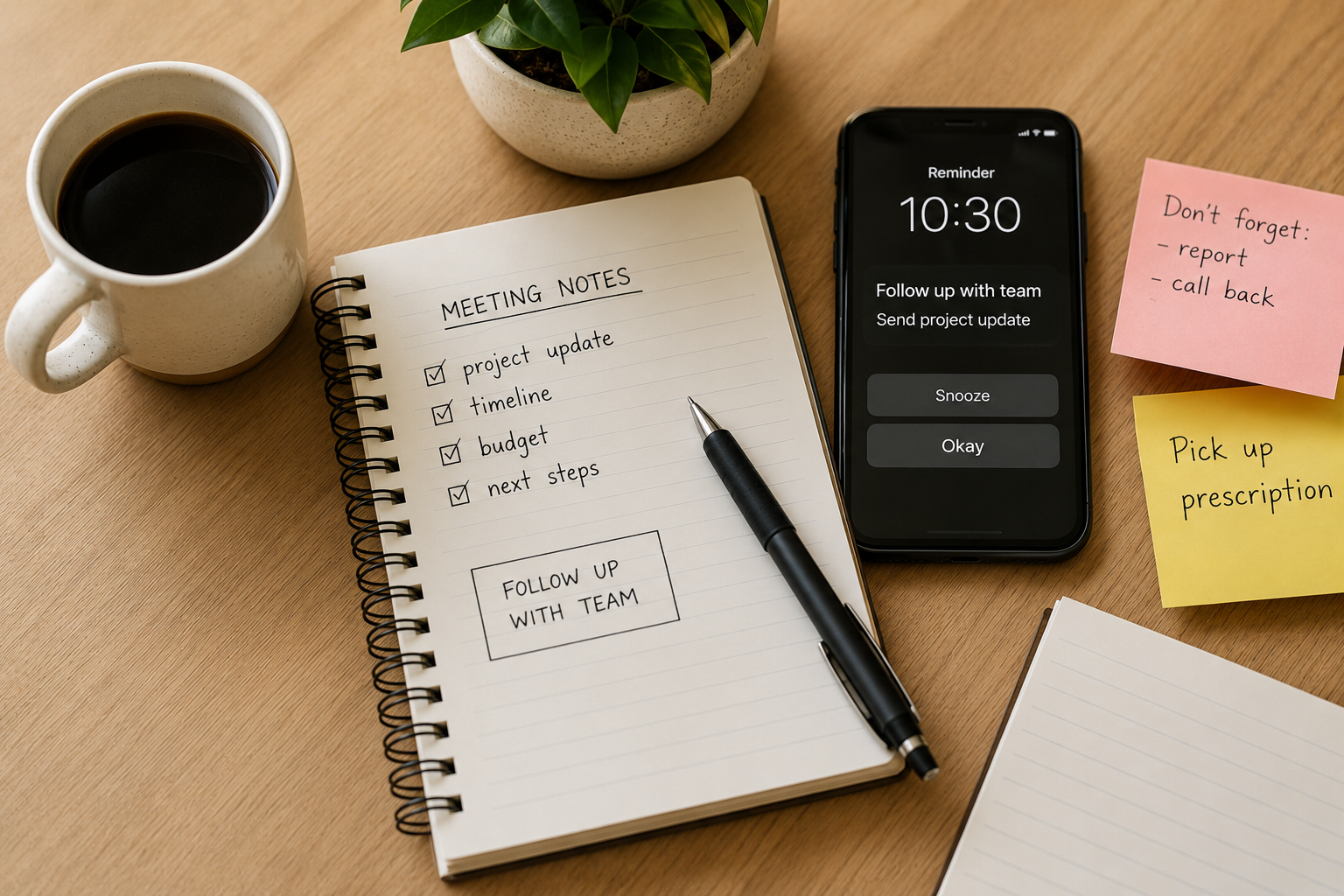
For me, support often means giving the detail somewhere to stay. A few written words, a visible cue, or a reminder that comes back later can make the day easier to manage.
What Is Working Memory?
Working memory is the mental space that holds information while you’re doing something with it. Think of it as the “hold it while you use it” skill.
You use it to follow a recipe, keep a question in mind while someone finishes speaking, or remember what you need to check before sending an email.
Even familiar tasks involve this kind of mental juggling. Laundry, dishes, packing a bag, and filling out a form all ask you to keep track of where you are and what comes next.
A review of research on working memory in adults with ADHD found that adults with ADHD performed less well on working memory tasks, on average, than adults without ADHD. That group finding doesn’t mean everyone has the same difficulties.
Working memory is one part of executive function. It works alongside the skills involved in planning, starting, shifting attention, and following through. I cover that broader picture in my guide that explains how ADHD affects executive function.
Working Memory vs. Short-Term Memory
Both involve holding information briefly. A useful distinction is what you’re doing with it.
Short-term memory holds information for a moment, such as a code you’ve just read. Working memory helps you hold and use information, such as keeping track of several instructions while carrying them out.
Find One Support to Try First
Start with the situation that keeps interrupting your day. You can try one support without building a whole new system.
| When this happens | Try this first |
|---|---|
| A useful thought disappears before you act on it | Capture a few words in one easy-to-reach place. |
| You forget a step while doing a task | Keep a short checklist beside the task. |
| Spoken instructions become hard to recall | Ask for written steps or repeat the order back. |
| You lose a thought while waiting to speak | Jot down a keyword that can help bring it back. |
| An interruption leaves you unsure where to restart | Leave a note showing where you stopped and what comes next. |
| You remember something when you can’t do it yet | Set a specific reminder for a time when you can act. |
These situations can involve attention and different memory processes. The table gives you a practical starting point, rather than a way to diagnose every forgotten detail.
7 Practical Working Memory Strategies for Adults With ADHD
A support needs to be easy to reach during an ordinary, busy day. Choose the one that fits your situation and adjust it if using it becomes another job.
1. Capture a Thought While It’s Still There
You remember something in the middle of doing something else: buy detergent, reply to a message, check the date on a form.
Save enough of the thought that you can understand it later. “Ask about Friday pickup” gives you more to work with than “school.”
A small notebook, a phone note, or a pad beside your keyboard can work. Choose somewhere you already look, because remembering to check a new list can become another task.
Capturing the thought also gives you a chance to continue what you were doing. You can write “buy detergent” without immediately opening a shopping app and leaving the original task behind.
2. Put a Visible Cue Where You’ll Use It
A cue is useful when you encounter it close to the moment you need to act.
If something needs to leave with you in the morning, placing it beside your bag can bring it back into view. If you’re working through paperwork, keeping the current form and its next step together can make it easier to pick up again.
Choose a cue that means something specific to you. A note saying “move towels to dryer” gives clearer direction than “laundry.”
Keep the surrounding space simple enough that you can notice it. The cue only needs to help you reconnect with the task.

3. Give Important Phone Reminders Another Chance
One notification can disappear into my day. I can see it, be in the middle of something else, and lose the reminder once my attention moves on.
For important things, a second or third notification gives me another chance to notice and act.
The wording matters too. “Send the completed permission form” tells me more than “school.” A useful reminder includes the action and arrives when I’m likely to have what I need.
If an alert comes at a bad time, try rescheduling it while it’s open. Use additional notifications selectively so the important ones remain noticeable.
4. Ask for Written Instructions or Repeat the Steps Back
“Can you send that to me so I have the steps right?”
That’s a practical request at work, during an appointment, or when sorting out plans at home. “Let me write that down” also creates a pause while the information is fresh.
Repeating the order back gives you a chance to check it: “So I’m updating the file first, then sending the note?”
For a conversation where you’re holding a question rather than following instructions, a keyword may be enough. You’re leaving yourself a way back to your thought without trying to write down everything being said.
5. Keep the Steps Short Enough to Follow
“Clean the bedroom” names the whole job. “Put the clothes from the floor into the basket” gives you one action to take.
For a task where you often lose your place, write a short sequence and keep it beside you. Check off steps as you finish them so the list also shows what’s already done.
Focus on tasks that repeatedly send you back to the beginning to work out where you were. You don’t need detailed instructions for everything.
If the same sequence comes up often, my guide to simple ADHD routines explores ways to make it easier to return to.
6. Leave Yourself a Return Point Before Switching Tasks
Sometimes I need to say, “Hold on, I need to get to a stopping point,” before I can give someone my attention. Those few seconds matter when I’m trying to keep my place.
A short return note can preserve the detail you’ll need when you come back:
- “Checked rows 1–12. Start at row 13.”
- “Draft finished. Confirm the date.”
- “Next: fold the towels.”
A half-written sentence, a checked box, or a cursor left in the right spot may be enough for a simpler task.
Write the clue the way you’d say it to yourself later, tired and already annoyed that you have to restart. It only needs to make sense to you.
7. Give Everyday Items a Usual Place
A consistent spot for keys, school papers, or unfinished paperwork removes a few questions from the day.
Start with something you regularly search for. Notice where you use it and where it tends to land. A location near that spot may be easier to maintain than one chosen because it looks tidier.
Keeping supplies together can also make a task easier to resume. You spend less time collecting what you need before you can get back to it.
This kind of support can feel boring when it works. There’s less searching and less figuring out where everything went, which leaves you with fewer details to keep track of.
What Working Memory Difficulties Look Like in My Day
These are some of the situations that make working memory difficulties most noticeable for me. Your own pattern may look different, but the details can help explain why an ordinary task sometimes takes so much effort.
Cleaning Can Turn Into a Series of Detours
I can start cleaning one room, notice something that belongs somewhere else, and carry it away. Then I see something in that other room that needs picking up and figure I’ll do it quickly before getting back to what I was doing. By the time I return, I’ve lost my place and have to work out what I was doing before I left.
I’ve been moving and doing things the whole time, but the original task has lost its order.
That’s part of what makes cleaning frustrating for me. I know how to do the individual jobs. Keeping the sequence connected gets harder when each step brings something else to my attention.
I Can Follow a Meeting and Still Need the Recording
I can understand a meeting while it’s happening and still need to listen to the recording afterward.
Listening, processing the information, and taking useful notes at the same time is a lot for me to manage. Following the discussion doesn’t always mean I leave with every detail I need to act on.
When a recording is available and permitted, it gives me another pass at the information. I can return to the parts I need without trying to catch everything while the conversation keeps moving.
My Words Can Come Back After the Conversation Is Over
In an emotional conversation, I can know what I want to explain and then struggle to reach it once the pressure rises.
I’m trying to follow what’s being said, respond, and keep my own point available. Sometimes the words come back later, after things have settled down.
That can be frustrating when the thought mattered and I wanted to say it at the time. A pause or a lost sentence doesn’t show all the effort going into finding the point again.
An Open Document Doesn’t Always Tell Me Where I Left Off
When I return to a spreadsheet or document after an interruption, I sometimes need to reconstruct what I was doing.
I may recognize the work but need to reread it to remember which detail I was checking or what I had just decided. The interruption can be brief, while finding my way back takes longer.
That quiet rebuilding is part of the work too. From the outside, it can look like I’m simply sitting there looking at the same screen.
When Working Memory Struggles Need More Support
Repeatedly recovering dropped details can become exhausting. Missed steps, unfinished tasks, and extra checking can take a toll at work and at home.
I’ve also used extra preparation and repeated checking to keep up. Those habits can make the effort less visible to other people, even when they take a lot out of me.
For women whose ADHD was recognized later, that effort can be part of a much longer pattern. I explore this further in my guide to ADHD in women.
Consider discussing memory difficulties with a healthcare professional when they regularly affect work, relationships, daily responsibilities, or safety. New or worsening changes also deserve attention rather than being automatically attributed to ADHD.
Bring a few examples of what happens, when it happens, and what you’ve tried. Sleep, stress, medication effects, and other health factors may also need consideration. The NHS explains when to seek help for memory problems and why it’s important to check for other causes.
Practical supports and professional care can work together. If every system becomes another thing you have to maintain, that’s useful information about what needs to change.
Common Questions About ADHD Working Memory
Does ADHD affect everyone’s working memory the same way?
No. Difficulties vary between people and situations. A familiar task in a quiet setting can feel very different from following new instructions while several things compete for your attention.
The situations that repeatedly cause difficulty are a useful place to focus your support.
Why can I remember something interesting but forget an instruction?
Recalling information about a familiar interest is different from holding a new instruction in mind while carrying it out.
Remembering one kind of information well doesn’t mean every memory task will be equally easy. An instruction may need to stay available through movement, decisions, or interruptions before you can use it.
Can these strategies improve working memory?
These strategies are intended to make everyday tasks easier to manage by reducing how much information you need to hold in mind. They don’t promise to increase memory capacity.
Progress can look like finding your place more quickly, having the instructions when you need them, or spending less time reconstructing the next step.