Last updated: August 6, 2026
ADHD working memory in adults can make everyday tasks feel harder than they look. If you keep forgetting steps mid-task, losing your train of thought, or blanking after spoken instructions, working memory is probably part of the problem.
Working memory helps you hold information in your mind while you use it. ADHD can make that harder during interruptions, conversations, errands, chores, meetings, and routines with more than one step. You might understand what needs to happen, then lose the next move before your brain can act on it.
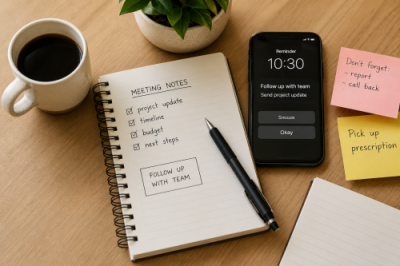
Instead of relying on willpower alone, it helps to create ways for important information to be captured and held outside your mind so it doesn’t slip away.
In this guide:
- What ADHD working memory actually is
- Working memory vs short-term memory
- Why ADHD can make working memory feel unreliable
- ADHD working memory symptoms in adults
- Why you forget steps mid-task
- Why spoken instructions are hard with ADHD
- Why you lose your train of thought with ADHD
- Why interruptions can wipe the slate clean
- What helps ADHD working memory in adults
- When working memory struggles need more support
- Quick answers about ADHD working memory
What ADHD Working Memory Actually Is
Working memory is the mental space that holds information while you’re doing something with it.
It’s the part that helps a thought stay available long enough to become a sentence, a choice, a direction, or an action. With ADHD, that space can feel unreliable, especially when there’s noise, pressure, movement, or something else asking for attention at the same time.
Working Memory Is the “Hold It While You Use It” Skill
A simple way to think about working memory is the “hold it while you use it” skill.
It helps with the mental juggling tucked inside ordinary tasks. Making lunch still asks the brain to remember what comes next. A conversation asks it to hold onto a point while someone else finishes talking. Even walking away from a task for a minute asks the brain to come back and find where it left off.
For adults with ADHD, that holding space can fill quickly. A question, message, sound, or passing thought can pull attention away before the information has a chance to settle. A moment later, the thing that felt clear can feel oddly out of reach.
Why It Matters for Everyday Adult Life
Working memory affects the parts of life that look simple from the outside.
A recipe gets harder after one distraction. Spoken instructions make sense while they’re being said, then fade before there’s a chance to use them. A work task can stall even when the person understands what the task is and wants to finish it.
That last part matters. A person can care, try hard, and still lose access to the small piece of information they needed in the moment.
Support usually starts by lowering how much the brain has to hold at once. When important information is easier to see, check, or come back to, working memory doesn’t have to carry the whole job alone.
Working Memory vs Short-Term Memory
Short-term memory and working memory are easy to mix up because both deal with holding information for a short time. The difference comes down to what the brain has to do with that information.
Short-term memory gives information a brief holding spot. Working memory has to keep that information active while something else is happening.
Short-Term Memory Stores It for a Moment
Short-term memory holds a small amount of information briefly.
A confirmation code, a name someone just said, or the first part of a sentence can stay available for a few seconds before it fades. That short hold can be useful on its own, especially when the information doesn’t need much action.
The job is narrow. The brain is keeping something nearby for a moment.
Working Memory Uses It in Real Time
This is where the memory has to stay useful while something else is happening.
It keeps a confirmation code in mind as you return to the login screen, holds part of a direction while the rest is given, and maintains a detail while the brain decides what to do next.
That extra “using it” piece is where ADHD working memory often gets strained. The brain has to hold the information while listening, moving, choosing, responding, or switching focus. A quiet memory task turns into a moving one.
Why the Difference Matters With ADHD
The working memory vs short-term memory difference matters because adult life rarely gives information a calm place to sit.
A direction can be heard clearly and still fade before it turns into action. A thought can feel clear during a conversation and then get harder to reach when there’s finally room to say it.
For adults with ADHD, support works better when the information stays easy to check. A written step, quick note, repeated instruction, or visible cue can keep the useful piece available after the moment has moved on.
Why ADHD Can Make Working Memory Feel Unreliable
With ADHD, working memory often gets shaky in the handoff between thinking and doing.
A step can feel clear for a second, then lose its place before action starts. That gap is frustrating because the task itself can make sense. The challenge is keeping the usable piece close enough to reach while the brain is also sorting what else is happening.
Information Drops When Attention Shifts
Attention shifts are one of the main reasons working memory feels unreliable with ADHD.
A person can be on the way to do something, then a question or thought cuts in. The original step doesn’t always vanish completely. It becomes harder to access at the moment it’s needed.
That quick shift can make a familiar task feel oddly confusing. The general goal is still there, but the next move takes more effort to find.
Mental Load Leaves Less Room for the Next Step
Mental load takes up working space.
A busy morning can already carry pressure, unfinished tasks, and details that keep tugging at attention. One more step has to compete with whatever else the brain is trying to hold.
The step loses room when the brain is already carrying too much at once.
Working Memory Is One Part of Executive Function
Working memory is one part of executive function. It helps keep information available while the brain plans, shifts, organizes, starts, and follows through.
That connection matters because working memory works alongside the rest of the executive function system. When attention moves, a plan changes, or a task gets interrupted, the brain has to carry useful information across that shift. Follow-through gets harder when that piece drops.
For a broader look at the full system, I cover more in my guide on how ADHD affects executive function.
Attention, sensory load, emotional regulation, time awareness, and task initiation can all affect follow-through. Here, we’re looking at one specific piece: the moment when something was clear, then suddenly takes more effort to reach.
ADHD Working Memory Symptoms in Adults
ADHD working memory symptoms in adults tend to show up in the middle of ordinary life, which makes them easy to brush off at first. The pattern is usually specific: information is there for a moment, then becomes harder to use at the exact time it’s needed.
These moments can look small from the outside, but they interrupt the flow of a task, conversation, or routine. Over time, that gets tiring.
Forgetting the Next Step
Forgetting the next step is one of the clearest working memory problems in adults with ADHD.
A person can be in the middle of a familiar task and suddenly lose the order of what comes next. The task itself still makes sense, but the sequence has to be rebuilt before anything moves forward again.
That pause can feel strange because it doesn’t always match the difficulty of the task. Something simple can still get tangled when the brain has to hold the order in real time.
Losing Thoughts During Conversations
Conversations put pressure on working memory because a thought has to stay available while another person is still talking.
The idea may feel clear at first. Then the conversation keeps moving, and by the time there’s space to respond, the words are harder to find. The thought often comes back later, which can make the moment feel even more frustrating.
For adults with ADHD, this can happen even when the person is interested, engaged, and trying to follow along.
Blanking After Instructions
Spoken instructions can be hard to keep active, especially when they include more than one part.
A direction may make sense while it’s being said, then fade once it’s time to act on it. That gap can be embarrassing in work, school, medical, or family settings because it’s easy for other people to mistake it for not listening.
The usable part of the instruction has to stay clear long enough to become action.
Forgetting What You Meant to Do After Switching Rooms or Tabs
Switching rooms, tabs, or tasks can break the thread quickly.
A person may walk into another room, open a browser tab, or pick up a phone with a clear purpose, then lose the reason during the shift. The movement itself creates enough of a break for the original intention to get harder to reach.
That’s one reason ADHD working memory symptoms in adults can feel so inconsistent. The intention was real, but it didn’t stay active through the transition.
Remembering Later, After It Is No Longer Useful
One of the more irritating parts of working memory is remembering too late.
The question comes back after the meeting ends. The form comes to mind after leaving the house. The missing item appears in memory after checkout. The information wasn’t fully gone, but it missed the useful window.
That late return can carry a lot of shame, especially for adults who spent years being called careless, scattered, or lazy. Late-diagnosed women often learn to cover those gaps by over-preparing, apologizing, checking things repeatedly, or trying to carry every detail in their heads. I talk more about that pattern in my guide on why ADHD in women can be missed for years.
Memory also changes with sleep, stress, hormones, anxiety, sensory overload, and plain life overload. ADHD working memory has a particular feel when the information was available, the moment moved, and the usable piece became harder to reach before it could turn into action.
The next sections look more closely at the places working memory struggles tend to show up most: steps, spoken instructions, conversations, and interruptions.
Why You Forget Steps Mid-Task
Forgetting steps mid-task can feel especially frustrating because you’ve already started. The plan was there, the task was moving, and then the order gets blurry enough that you have to stop and figure out where you were.
With ADHD working memory, this often happens when a task has more moving parts than it seems to from the outside. Your brain is holding the action, the order, the reason for doing it, and whatever else keeps pulling at your attention.
Multi-Step Tasks Ask Your Brain to Hold Too Much at Once
Multi-step tasks put pressure on working memory because the order has to stay active while the task is happening.
Cleaning is a good example. You start in one room, notice something that belongs somewhere else, and carry it away. By the time you come back, the room is still waiting, but the original plan feels less clear.
Plenty of effort can be happening while the order still falls apart. That’s the frustrating part of a task like cleaning: the body keeps moving, but the plan keeps needing to be rebuilt.
Quick tasks can stretch out the same way. A job that looked like it should take five minutes can turn into a longer loop of stopping, remembering, restarting, and wondering how it got so scattered.
Interruptions Break the Invisible Chain
Some tasks are held together by an invisible chain. The order is active in your mind, but it hasn’t been written down, marked, or anchored anywhere yet.
An interruption can break that chain fast. Someone asks a question, a message pops up, or another thought cuts through before there’s a clean stopping point. Afterward, the task may still be right there, but the order takes more work to recover.
One small support is pausing before switching attention. Saying, “Hold on, let me get to a stopping point,” gives your brain a few seconds to finish the part it was holding. It sounds small, but it can keep a task from falling open in the middle.
That pause matters most when the task is being held together mentally. Once the sequence only lives in your head, even a quick interruption can make the whole thing harder to re-enter.
The Task Can Be Simple While the Sequence Is Hard to Hold
Even a simple task can put pressure on working memory.
Laundry, dishes, email, packing a bag, or filling out a form all have an order. The steps are familiar, but they still have to stay connected long enough to finish. With ADHD, that order can get slippery once attention moves.
That’s when a basic task starts to feel oddly bigger than it should. You know how to do it. You know why it matters. The hard part is finding the small thread that tells you where to start again.
A short written cue can help. So can a reset point or a routine with fewer decisions built into it. I go deeper into that in my guide to simple ADHD routines that are easier to come back to.
Forgetting steps mid-task is often about the sequence losing its shape. The more that sequence has to live only in working memory, the easier it is for the task to scatter before it’s done.
Why Spoken Instructions Are Hard With ADHD
Spoken instructions put pressure on working memory because there’s nothing to look back at once the words are gone.
For ADHD working memory in adults, that matters. The brain has to listen, process the meaning, hold the order, and get ready to act, all while the other person may still be talking. Even when the instruction makes sense, it can fade before it becomes usable.
Spoken Instructions Disappear Fast
Spoken directions move quickly. They don’t wait on the counter or stay open on a screen.
That creates a rough setup for ADHD working memory. A person can be listening carefully and still lose the first part while the rest of the instruction is coming in. The detail was heard, but it didn’t get enough time to settle.
Meetings are a good example. You can follow the conversation while it’s happening, then need the recording later because listening, processing, and taking notes at the same time takes more working memory than people realize. The recording gives you a second pass without the pressure of keeping everything active in the moment.
Multi-Step Directions Are Harder Without a Visual Cue
Multi-step directions get tricky because the order has to stay clear.
“Send the file, update the note, and check the date before replying” gives the brain several pieces to hold at once. Without something written down, those pieces start blending together. The general request may still be there, but the exact order gets fuzzy.
It gets harder when the topic doesn’t naturally grab your interest or the person keeps talking while you’re still trying to hold the first part. The brain is still working with the first instruction while more words are arriving on top of it.
A visual cue gives the instruction something solid to attach to. A message, quick note, or short checklist keeps the steps available after the conversation moves on. That’s often what makes written instructions easier than spoken ones for adults with ADHD.
What to Ask for Without Feeling Awkward
Asking for directions in a different format can feel uncomfortable, especially after years of trying to look like you’re keeping up.
It helps to keep the request simple and practical. “Can you send that to me so I have the steps right?” works because it’s focused on accuracy. “Let me write that down” also gives you a pause without turning it into a big explanation.
Repeating the order back can help too. Saying, “So I’m updating the file first, then sending the note,” gives working memory another pass at the instruction and gives the other person a chance to correct anything missing.
For ADHD spoken instructions, the support needs to happen while the information is still fresh. Once the moment passes, the brain has to work much harder to rebuild what was said.
Why You Lose Your Train of Thought With ADHD
Losing your train of thought with ADHD feels frustrating because the idea was there, had a shape, and felt close enough to say. Then the conversation moved, another idea cut in, or the pressure of responding made the words harder to reach.
For ADHD working memory in adults, this often happens in the space between forming a thought and getting it out. The brain is holding the idea while also listening, waiting for a pause, choosing words, and tracking the other person’s reaction. That’s a lot for one thought to survive before it becomes a sentence.
Thoughts Can Vanish When Another Thought Interrupts
In conversation, a new idea can cut across the one already being held.
The brain follows the newer thread for a second, and the original point starts to lose its shape. By the time there’s a pause, the person still knows there was something worth saying, but the words are harder to find.
Writing has its own version of this. A sentence starts clearly, then another angle shows up halfway through. The cursor keeps blinking while the original point has to be rebuilt from whatever pieces are left.
Those moments are irritating because the thought often comes back later, when there’s no pressure to explain it or fit it into the conversation.
Pressure Makes Recall Harder
Pressure makes the missing thought feel farther away.
In a meeting, the idea can feel clear while someone else is talking. Then the moment opens, and the brain starts tracking the room instead of the sentence. How long has the pause been? Is this the right time to jump in? Did the point already pass?
That extra pressure takes up space. The thought has to compete with timing, tone, facial expressions, and the fear of sounding scattered. For adults with ADHD, that can be enough to make a clear idea go quiet.
Emotional conversations add another layer. A point that felt obvious alone can disappear once urgency, conflict, or someone’s tone enters the room. The words often come back later, after the pressure drops.
Losing the Thread Can Be Misunderstood
When someone loses the thread mid-conversation, other people don’t always read it accurately.
A person might pause, circle back, repeat the beginning of a sentence, or say, “Wait, I had it.” From the outside, that can look like distraction, nervousness, or poor listening. Inside, the person is trying to find the thought again before the conversation moves too far ahead.
Some adults learn to talk around the missing point. Others go quiet because losing the thread in front of people starts to feel risky. That’s especially hard when the thought was useful, thoughtful, or important, but disappeared before it came out clearly.
The strain comes from holding an idea long enough to say it while the conversation keeps moving around it. That’s one reason “why do I lose my train of thought with ADHD” is such a common question.
Why Interruptions Can Wipe the Slate Clean
Interruptions do more than pause a task. They can strip away the small bit of context that made the task easy to continue.
With ADHD working memory, the hardest part often comes after the interruption ends. You come back to the open message, the half-finished form, or the thing sitting on the counter, and it looks familiar. Finding the exact place where your brain left off takes extra work.
The Original Task Loses Its Place
A task has a mental shape while it’s active.
There’s a loose sense of what just happened, what needs attention, and why the task was open in the first place. An interruption can scatter that shape before it has a chance to settle.
When attention comes back, the outside of the task may look unchanged. The inside track takes longer to find. The task is familiar enough to recognize, but the way back in takes a minute.
That in-between feeling can be surprisingly draining. You’re looking at something you were just doing, and still have to rebuild enough context to keep going.
Restarting Takes Extra Work
Restarting after an interruption takes more than remembering the task exists.
The brain has to recover the last usable thought, sort through whatever came in during the interruption, and figure out what still matters. A spreadsheet, email, form, or half-written paragraph can take a few minutes to feel clear again.
That quiet rebuilding is a real part of the work. Someone watching may see a pause, while the work happening inside is context recovery.
For adults with ADHD, interruptions often cost more than the minute they took. The extra time goes into finding the thread again.
A Placeholder Can Protect the Next Step
A placeholder gives ADHD working memory something to grab when attention gets pulled away.
One of the simplest ways to protect that context is to pause before switching attention. Saying, “Hold on, I need to get to a stopping point,” gives the brain a chance to finish the piece it was holding instead of dropping it midstream.
A placeholder can be plain. A half-written sentence, a sticky note, a cursor left in the right spot, or a quick “check totals next” can hold enough context to make restarting easier.
The wording matters less than the cue. It just needs to make sense to your future tired brain.
That small pause before switching focus can save a lot of rebuilding later. A visible clue keeps the task from depending entirely on memory once the moment has been interrupted.

What Helps ADHD Working Memory in Adults
ADHD working memory support works best when important information is easier to notice, check, and pick back up after the day starts pulling your attention in different directions.
The best supports are usually plain and useful. They give your brain something outside itself to work with, especially when a task has too many pieces, a conversation moves quickly, or an interruption breaks the flow.
Capture the Next Step Before It Disappears
The next action is often the most useful thing to save first.
A full plan can take more energy than you have in the middle of a busy day. Working memory usually needs one clear action that tells you how to keep moving. A quick note like “wipe counters, then start dishwasher” is more useful than a vague reminder like “kitchen.”
Messy notes are fine when the action is clear. The point is to catch the usable part before the moment moves on.
Use Visible Cues Instead of Mental Reminders
Mental reminders are easy to lose because they have to stay active in your head.
A visible cue gives the reminder a real place in the room. If something needs to leave with you in the morning, putting it near the door gives your brain a signal at the moment you need it. If a form needs to be finished, leaving it open where you’ll see it can help the task come back into view.
The cue works because it meets you where the action happens.
Use Phone Reminders for Details That Can’t Stay in Your Head
Phone reminders can help when a detail needs to come back later instead of staying active in your mind all day.
For some adults with ADHD, iPhone reminders and calendar alerts work better when they include more than one notification. One alert can disappear into the day. A second or third alert gives the reminder another chance to break through at the right time.
This works especially well for appointments, forms, school tasks, errands, work follow-ups, and anything that becomes invisible once it’s no longer right in front of you. If the detail only lives in your head, it has to survive every interruption, thought, and task switch that happens before you need it again.
Ask for Instructions in Writing or Repeat Them Back
Spoken instructions put a lot on working memory, especially when there’s more than one step.
Getting the details into writing protects the order before it starts blending together. A simple request like “Can you send that to me so I have the steps right?” keeps the focus on accuracy and gives you something to check later.
Repeating directions back also helps. Saying, “So first I update the file, then I send the note,” gives your brain another pass at the instruction while the other person is still there to clarify.
Keep Steps Short Enough to Use
Long instructions can make a task feel heavier before it even starts.
A short step gives the brain one action to hold. “Put laundry in the basket” is easier to use than “clean the bedroom,” because it gives the task a smaller doorway. Once that part is done, the next piece is usually easier to see.
Smaller steps help because the brain has less to hold while the task is already in motion.
Leave Yourself a Return Point Before Switching Tasks
Switching tasks goes more smoothly when there’s a clue waiting for you when you come back.
Before stepping away, leave yourself a plain note about where to restart. A half-written sentence, a checked box, or “next: check totals” can save you from rereading everything just to figure out what you were doing.
Plain language works best here. Write the clue the way you’d say it to yourself later, tired and already annoyed that you have to restart.
Reduce Background Decisions
Working memory gets more room when fewer small decisions are competing for attention.
A usual spot for keys, a repeated place for school papers, or a basic morning order can remove a few questions from the day. The same decision doesn’t have to be remade every time.
This kind of support can feel boring when it works, which is part of why it helps. There’s less searching, less rethinking, and less trying to remember what the plan was supposed to be. More of the day can run through visible cues and familiar patterns instead of being carried in your head.
When Working Memory Struggles Need More Support
Some working memory struggles can be handled with clearer notes, written instructions, visible reminders, or fewer steps held in your head at once. Other patterns start taking up too much energy.
If forgetfulness keeps affecting work, home, relationships, safety, or basic follow-through, it makes sense to bring in more support. That pattern deserves more than another reminder you have to remember to check.
When Forgetfulness Is Affecting Work, Home, or Relationships
Working memory problems in adults deserve attention when the same issues keep creating stress.
At work, that might look like missed details, repeated cleanup, or needing more time to recover after interruptions. At home, the same tasks may keep reopening because one part gets forgotten or dropped. In relationships, forgotten requests can start carrying more emotional weight than anyone meant for them to carry.
The pattern matters more than one messy day. Everyone forgets things. A repeated cycle of dropped details, unfinished tasks, apologies, and extra cleanup can wear down confidence over time.
ADHD working memory support can include practical changes, therapy, coaching, medical care, workplace support, or a mix of those. Having someone else look at the pattern can make it easier to stop treating every missed detail like a character flaw.
When Symptoms Are New, Worsening, or Concerning
A sudden change in memory, focus, or follow-through is worth discussing with a medical professional.
ADHD can affect working memory, and memory can also be shaped by sleep, stress, hormones, medication side effects, anxiety, depression, burnout, or other health issues. If the change feels sharper than usual, shows up suddenly, or starts affecting driving, finances, safety, work, or daily responsibilities, it’s worth getting checked.
A clinician can help sort through what changed and what kind of support fits. That matters because the right help looks different when the main strain is ADHD, poor sleep, medication timing, burnout, anxiety, hormones, or something else happening in the body.
Getting checked is a practical step. It gives you more information instead of leaving you to guess.
Why Support Can Be Practical, Medical, or Both
ADHD working memory help for adults can come from more than one direction.
Practical support can make daily information easier to manage. That might mean written instructions, visible cues, shorter steps, routines with fewer decisions, or systems that are easier to return to after interruptions.
Medical or therapeutic support can matter when focus, mood, sleep, anxiety, hormones, medication, or overall functioning are adding to the strain. A doctor, therapist, coach, or workplace support person can help you figure out what belongs in a daily system and what needs a different kind of care.
Support should make life easier to carry. If every system becomes another thing to maintain, it probably needs to be simpler. Handling it alone can start costing more energy than the support would.
Quick Answers About ADHD Working Memory
These quick answers cover the questions people often search when ADHD working memory starts affecting everyday life. Each one gives the short version without re-teaching the full article.
What is ADHD working memory in adults?
ADHD working memory in adults is the ability to hold information long enough to use it. It helps you keep track of a step, a thought, an instruction, or the reason you started something.
Is working memory the same as short-term memory?
Working memory and short-term memory are related, with different jobs. Short-term memory holds information briefly. Working memory keeps that information active while you’re doing something with it.
Why do I forget what I was doing with ADHD?
With ADHD, the original purpose can get harder to reach once something else pulls attention away. You might remember the general task, but lose the order, reason, or place to restart.
Why do I lose my train of thought with ADHD?
People often search “why do I lose my train of thought with ADHD” because the thought can feel clear one moment and hard to find the next. Working memory has to hold the idea while you listen, wait, choose words, and respond.
Why are spoken instructions hard with ADHD?
Spoken instructions are hard with ADHD because the information has to be caught while it’s still being said. Without a written cue, the brain has to hold the order, details, and action all at once.
Can ADHD make you forget steps mid-task?
Yes. Multi-step tasks ask working memory to hold the order while the task is already happening. With ADHD, that order can get fuzzy after interruptions, extra decisions, or anything that pulls focus.
What helps ADHD working memory?
What helps ADHD working memory most is giving important information somewhere easier to check. Written steps, visible cues, shorter instructions, repeated directions, and simple restart clues can all reduce how much has to stay in your head.
Is working memory part of executive function?
Working memory is part of executive function. It helps with planning, starting, shifting, organizing, and following through by keeping useful information available while the brain is using it.
Can working memory improve with ADHD support?
Working memory can become easier to manage with the right ADHD working memory support. Outside reminders, simpler routines, written instructions, treatment support, coaching, therapy, or workplace accommodations can make daily follow-through less fragile.
When should I talk to a professional about memory problems?
Talk to a professional when working memory problems in adults start affecting work, home, relationships, safety, finances, or daily responsibilities. It’s also worth getting checked when memory changes feel new, sharper than usual, or connected to sleep, mood, hormones, medication, stress, or another health concern.